+880 1745-989313
Posted On: 25 Jul 2026By: Admin
🏗️ G+10 Building Foundation System | The Strength Beneath Every Structure
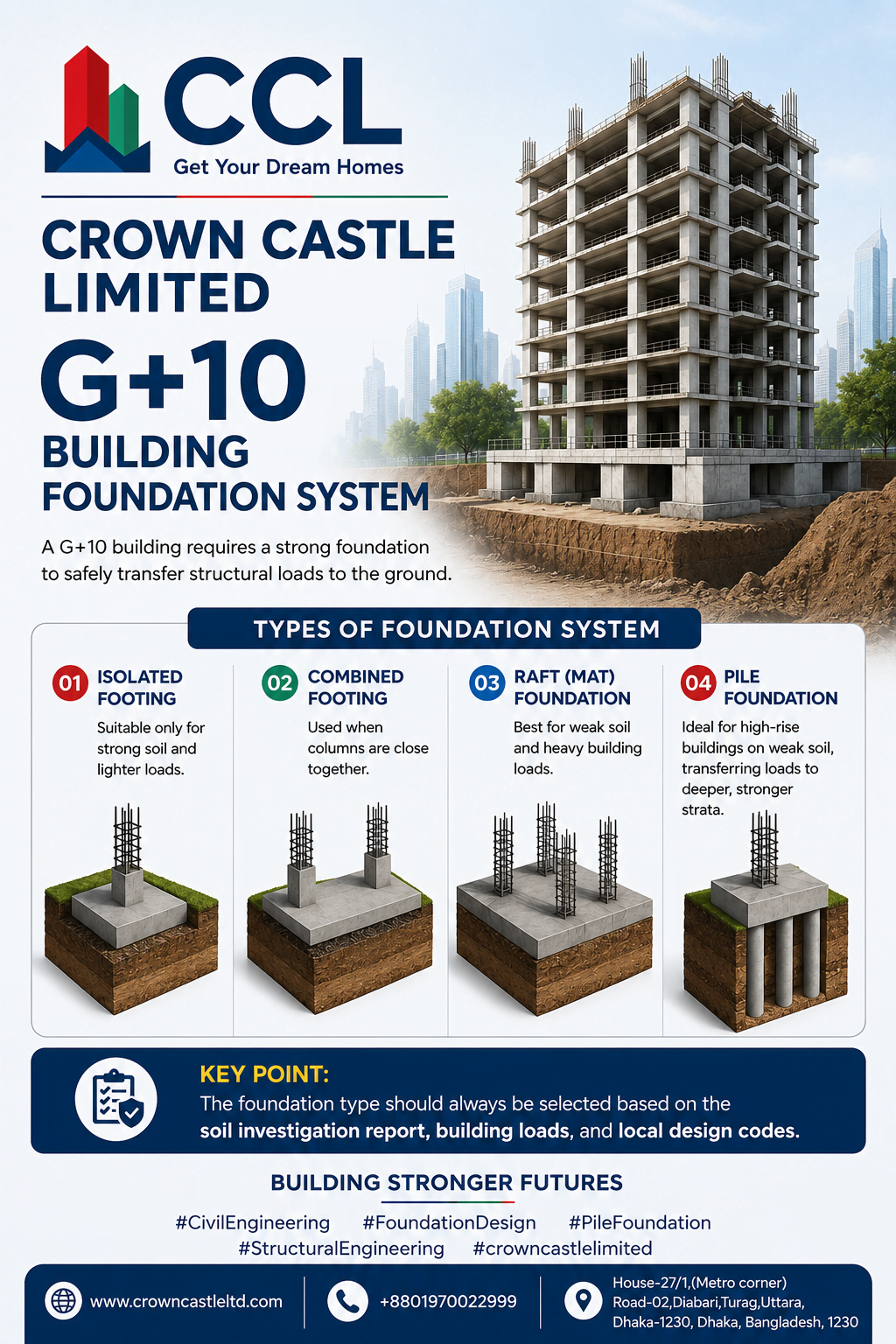
The safety, stability, and long-term performance of a G+10 building largely depend on how properly its Foundation System is planned, designed, and executed.
Before constructing a high-rise building, it is essential to understand the soil condition, soil bearing capacity, and structural loads of the building. Since every building has different requirements, the same foundation system may not be suitable for every project.
🔹 Isolated Footing
Suitable for strong soil conditions and comparatively lighter structural loads.
🔹 Combined Footing
Used when two or more columns are located close to each other and separate footings are not feasible.
🔹 Raft (Mat) Foundation
Suitable for weak soil conditions and heavy building loads, helping distribute the structural load over a larger area.
🔹 Pile Foundation
Ideal for high-rise buildings constructed on weak soil, transferring building loads to deeper and stronger soil strata.
📌 Key Point:
The foundation type should never be selected based on assumptions. It must be carefully determined through a proper Soil Investigation Report, Building Load Analysis, Structural Design, and compliance with Local Design Codes.
Because the beauty of a building can be seen above the ground, but its true strength begins beneath the ground.
🏢 Building Stronger Futures with Crown Castle Limited.
#CivilEngineering #FoundationDesign #PileFoundation #StructuralEngineering #BuildingConstruction #ConstructionEngineering #CrownCastleLimited